Tuesday, May 17, 2011

Te Amo Mama

Hi folks.

A lot’s been going on since I last wrote. I went for a fun trip to the coast and camping but you’ll have to wait to hear about that until the next blog. Or e-mail me or something. Or just stay posted for pictures on the facebook in the next couple of weeks. The reason I’m not going to write about vacation is because I would like first to write about this year’s Mother’s Day while it is still relevant. Actually, it may not be relevant at this point. But regardless, I would like to write about the wonderful holiday of Mother’s Day.

You may not know this, but Mother’s Day is an international holiday and has been celebrated in Peru since 1924. But the celebration is a little bit different here than we are used to in the United States.

Let’s start with what we’re used to encountering on Mother’s Day. If a mother in America is lucky, she will wake up on Mother’s Day morning to maybe some breakfast in bed cooked by her children (under the careful watch of their dad to avoid that memorable Mother’s Day kitchen fire) and will then pass the day spending quality time with her family. Sometimes they get more than that breakfast and are given flowers, a nice card, a small gift of chocolate or even a large gift to a spa. If you’re my mom (hi mom!), you got treated to, or lovingly put up with, the Mother’s Day musical at the First United Methodist Church of Palatine. But that is the extent of the holiday. It is generally a private family event with little tokens of affection and esteem and acts of love like cooking breakfast. The day is low-key and lovely.

You are probably guessing by now, that the Peruvian Mother’s Day is anything but low-key. I don’t know if I’ve written about it before but Peruvian parties are a little bit more um – intense than our own. Often lasting for days with the drinking starting early in the morning, when Peruvians throw a party, they THROW A PARTY. So I suppose, in relation to other Peruvian parties, Mother’s Day is actually pretty low-key. But, in comparison to my usual Mother’s Day, it is quite an event.

It started similarly; my host sister and I made a special juice for my host mom and I made her a card to say thank you for being my adoptive mom. But then things turned a little different. I went out to see what was going on at 8:30 in the morning and was offered a beer from a mom who was celebrating her day. I respectfully declined feeling that it was a little too early in the morning for beer. But what were the children doing for their moms’ day?

The week before, each class had prepared large posters about mother’s day and submitted them for the school’s contest. I was drafted to be a judge and helped choose the winners to be displayed that Sunday in the plaza.

Come Sunday morning, the kids were running around selling popcorn and ice cream and preparing for the show they would put on in the plaza. Around 11:00, they show began. Each class had prepared either a dance, poetry, or a little skit.

The moms, meanwhile, watched from the side and enjoyed some party food. Occasionally, a few would be invited to participate in silly eating or balloon popping contests and would hold raffles for mother’s day gift baskets put together by the students. I, myself, bought a raffle ticket to try to win a sheep. I don’t know what I would have done with it had I won, but I was glad to support the fundraising efforts of the high school students. When the show was over, the moms were treated by the municipality to lunch. ALL of the moms in the town were served a plate of Pachamanca. I don’t know if I’ve written about this meal yet (it probably deserves its own blog) but let’s explain it here by saying simply that it’s the picnic food of Peru. Upon receiving their plate piled high with chicken, broad beans, potatoes and sweet potatoes, the moms also received their gift bag from the municipality.

Later in the afternoon, the moms formed their teams and got the volleyball tournament. Everyone kept asking me why I wasn’t playing and I had to explain that I wasn’t a mother. This sometimes prompted the response, “Oh, you’re not a mom yet?” or “Oh, you’re still not a mom?” I suppose this is understandable considering that I am older than a few of the moms who were out on that volleyball court. And when the tournament was over, that was the end of the day.

So. A little different. Mother’s Day in Peru is a big deal. The municipality is the one giving the gifts and preparing the special meal. The school is responsible for the day’s entertainment and the kids participate in it. It is a public holiday and an outlet for the moms to get together with each other and celebrate among each other their motherhood rather than being doted upon by their families all day. Still, both ways, demonstrate our love for our mothers. Since I’m “still not a mother,” I don’t think I know which I would prefer. What do you say moms?

Blessings.

Wednesday, April 20, 2011

IST Chapter 2

Hi everyone!

As promised, here is the much anticipated second tome regarding IST. In an effort to get this to you before I accrue more stories, I felt it important to get it out today. I think I briefly mentioned in the last one that traveling to Lambayeque, a landscape and reality completely unlike my own, helped cement in my mind that I am in the right place in my mountain top village. And to help you understand why, I present to you.... a top ten list! As you know, my top ten lists have no order of significance, however, this one actually does arrive and end at 10! So here we go.

Top 10 reasons why I prefer to live in the Sierra:

1. Capital city: My capital city is called Huancayo and it is in the department of Junin. The capital city in Lambayeque is Chiclayo. Chiclayo is actually a very nice city and has some easily-found karaoke and a fantastic pizza restaurant but giving the higher cost of living there, I think I prefer my grittier and more down to earth Huancayo.

2. Temperature: Now, I may have mentioned that it is cold in the sierra but it is HOT on the coast. We had temperatures in the upper 90's everyday, no air conditioning (of course) and the only relief was the shade or the slight breeze that appeared every now and then. I would be doing a lot more laundry if I were sweating through my clothes everyday like they do in Chongoyape. I'll stick to the cold.

3. Bugs: In the colder sierra, either I am more covered or there are less biting bugs but whatever the reason I receive significantly less bug bites in site. On my visit to the coast, despite my use of bug spray, in the first two days I had received 123 bug bites on my right leg from the knee down alone! The left leg came in just behind with 113. On the bright side, I got a lot of sympathy from the locals. The down side? I looked like a leper and itched like crazy.

4. Space: All the volunteers who live on the coast are very connected - in a geographic-layout-of-the-towns sense. It almost reminded me of being in the suburbs where you can't tell when you've gone from one town to the next. It is good in one way because there are many options and work opportunities for these volunteers. If you hit a brick wall in one town, just try the next one. But, I prefer my little isolated town up in the mountains because even if it is tough to get in and out, I know that I would be intimidated by the suburb atmosphere and would not know where to begin.

5. Air: Now, you may think that this is an argument in favor of the coast. After all, there is a lot more oxygen at sea level than at 3550 meters above sea level. But, nope. The air on the coast is thicker yes, but also thicker with humidity and pollution. The pro is that I can run forever but the only reason for that was because I have been training at altitude. Thank you 3550m! I went running with a friend and it was flat and oxygen abundant so that when we finished after 45 minutes I was hardly tired. But the only reason I could do that is because of where I live. I will stay with the think, pure air and maybe keep training for a sea level race.

6. Community: This speaks mainly to our regional meetings. In our region, we are a small group and it makes us tighter and self-sufficient. Also, we are only volunteers in the environment program and so are able to focus our conversations on topics relevant to everyone while volunteers in other regions are together with other sectors of development.

7. Vegetation: In my site, it is GREEN! On the coast, it is very brown and very sandy. It is part of the bosque seco ecosystem so it has some trees - ones that do well with low water and high heat (palo verde, palo santo, ficus). They are interesting just like the ecosystem that inhabit but I don't think I would appreciate it as much as I do my cultivated andenes.

8. Comfort: Now that's a nice, broad term, isn't it? One that can mean fluffy pillow top beds with down blankets and silk pajamas, a warm cup of tea and a good book inside on a snowy day...or it can mean a state of mind that you have while walking down the street. And it is the second comfort to which I am referring. In my site, there are few people, few cars and few cat calls. On the coast, it is the opposite. As a visitor, I found the catcalls entertaining and only slightly annoying. The worst is where the man will pucker his lips and make a sloppy wet kiss sound. That's just gross. But the funny ones involve the caller speaking in stilted and heavily accented english the one or two phrases they have managed to retain since high school. Usually it's just "heylo bayby" but my personal favorite was "I love you lady." But let's be clear: if I got that on a regular basis where I live, I would probably be driven crazy or in to a bitter and cynical woman - or both. But luckily, my site is small and the people know me and everyone knows that the #1 rule of catcalling is that you can't harass people you know. Lucky, lucky me.

9. Water: We have plenty of it in my site and I only have to boil it to make it safe to drink. On the coast, they only get water a few hours a day and most likely have to filter out the sediment as well as boil out the organisms. I bought water all that week and my wallet was not pleased. We also get lots of rain and with it, its calming effect. But we acknowledged, whether coast or sierra, you can't do hardly anything in the afternoons be it for the heat of the rain, respectively.

10. Soft serve ice cream: Now this one doesn't make sense, I know. It's downright counter intuitive. But when does anything ever make sense, really? So, in my capital city, there is 1 sol soft serve (that's about 40 cents)! And it is so good and it doesn't matter that it's a little bit chilly and it is way better than what the coast has to offer in terms of ice cream. On every corner on the coast, there are vendors selling chupetes - basically, homemade popsicles. The chocolate one was fantastic even after I realized it was basically frozen chocolate milk. They reminded me of making popsicles in ice trays when I was little.

So that about sums it up. The coast is nice for a visit but I am glad to be living where I am living here in Peru. Lest any of my Charleston readers fear that I am knocking the life on the coast, rest assured, I still love the coast and fully intend to settle on a coast some day. Just not the coast of Peru. There's got to be green, fresh air, lots of water, tight knit community and of course, ice cream.

Blessings.

Tuesday, April 5, 2011

For Love of our Leader

Hey folks

Happy April! Actually, I think that is a good place to start. Let's talk about April. Better yet, let's talk about the last week of March going in to April. I spent it with my other environmental volunteers in Chongoyape, Chiclayo, Lambayeque (this is one place and it is found in the hot, hot north, on the coast and much nearer to the equator). I could probably right a lot of things right here, right now on this blog about the trip but for the sake of your time and attention spans, I'll share the experience one story at a time. And oddly, we're working backwards. Because, while this story is fresh in my mind, I would like to share with you all, the story of my April 1st in Peru.

First. Some background. We spent all week doing training, giving and receiving powerpoints regarding our own sites, the sites of other volunteers, personal safety, health and well-being and technical work like building worm composting beds. The expositors of these talks were our safety and security officer, one of the Peace Corps doctors, our third year volunteer and of course our beloved APCD. Let me tell you a little bit about this man, Diego.

He is a man surrounded by legends, based on fact, woven, augmented and disseminated by his Peace Corps volunteers. Before working for the Peace Corps, he lived 10 years in the jungle working for an NGO and literally saving the rain forest. While there, he made a few enemies in the logging companies and decided to start carrying a gun after someone shot up his camp one night. This past week, he told us that he found out one of these men had had a stroke and here is the direct quote: "So...I guess that is the good news."

And somehow this BA, no-holds-barred (what a weird phrase), jungle saver came to work in our bureaucratic government agency that is Peace Corps as the director of the community-based environmental management program, a transition which I am told was not easy for him. He rolled in shaking things up in the establishment and flouting some rules. Flouting? I think that's the word. He's since calmed down and learned to work within the system and I think it's safe to say that he is more loved by his volunteers than any other APCD is by theirs. And with reason. He tries very hard to understand where we are coming from and be in tune with how we are feeling. He works hard and will go to the mat to stick up for us. And although he is our superior, he never talks down to us in that condescending tone reserved for misbehaving children. He has the support of his volunteers because he supports us with all that he is.

On top of all that, he is a family man. Happily married with two teenage children. And I think that is how despite all that he has seen and continues to see, he is able to maintain his sense of humor, mischievous grin and a twinkle in his eye.

And now that I've set the stage a little, I can begin to recount the things we did over training our of love for our leader.

First off, most of the men in our group set aside their razors for the month of March so they could participate in the "stache-off" to take place at training in homage to Diego, who has not been without a mustache in 25 years. When asked about it, he shared with us his personal philosophy: "Kissing a woman without a mustache is like eating an egg without salt." I don't know from who's point of few, but so goes the philosophy. So the last day of training, our esteemed judge evaluated mustaches from just a straight mustache to a go-tee a la conquistador and decided a winner. Here he is during the judging.

Ok, now I need to back track a little and just state this fact: Friday, our last day of training, was April 1st, aka - April Fool's Day. So naturally, we pranked our beloved boss. Here's how it went. We coordinated with the police in the town where we were staying, as well as our third year, the doctor and the safety and security officer to make sure that it wouldn't get out of hand. Friday morning, we all went to the police station and locked up two volunteers from our group (not me) while the rest of us went to hide. Our 3rd year called the boss and told him that two of his volunteers were in jail. He was there within minutes. The police cooperated beautifully, making up this story that the two co-ed "prisoners" had been found drunk, half-naked and entwined in the plaza during the night and so they had locked them up. Diego was about to explode with fury on pretty much everyone, I'm sure, when all of us came out of hiding and happily yelled "April Fool's!" He was confused for about a minute until the doctor explained that it had all been a joke. Then out came that well-known smile and twinkly eyes.
Here he is with the two culprits. Note the handcuffs on the right. He enjoyed the joke and explained that Peruvians do something like that on December 28, Dia de los Inocentes. He also warned us that "revenge will be sweet." So I will be on the alert come the end of December.

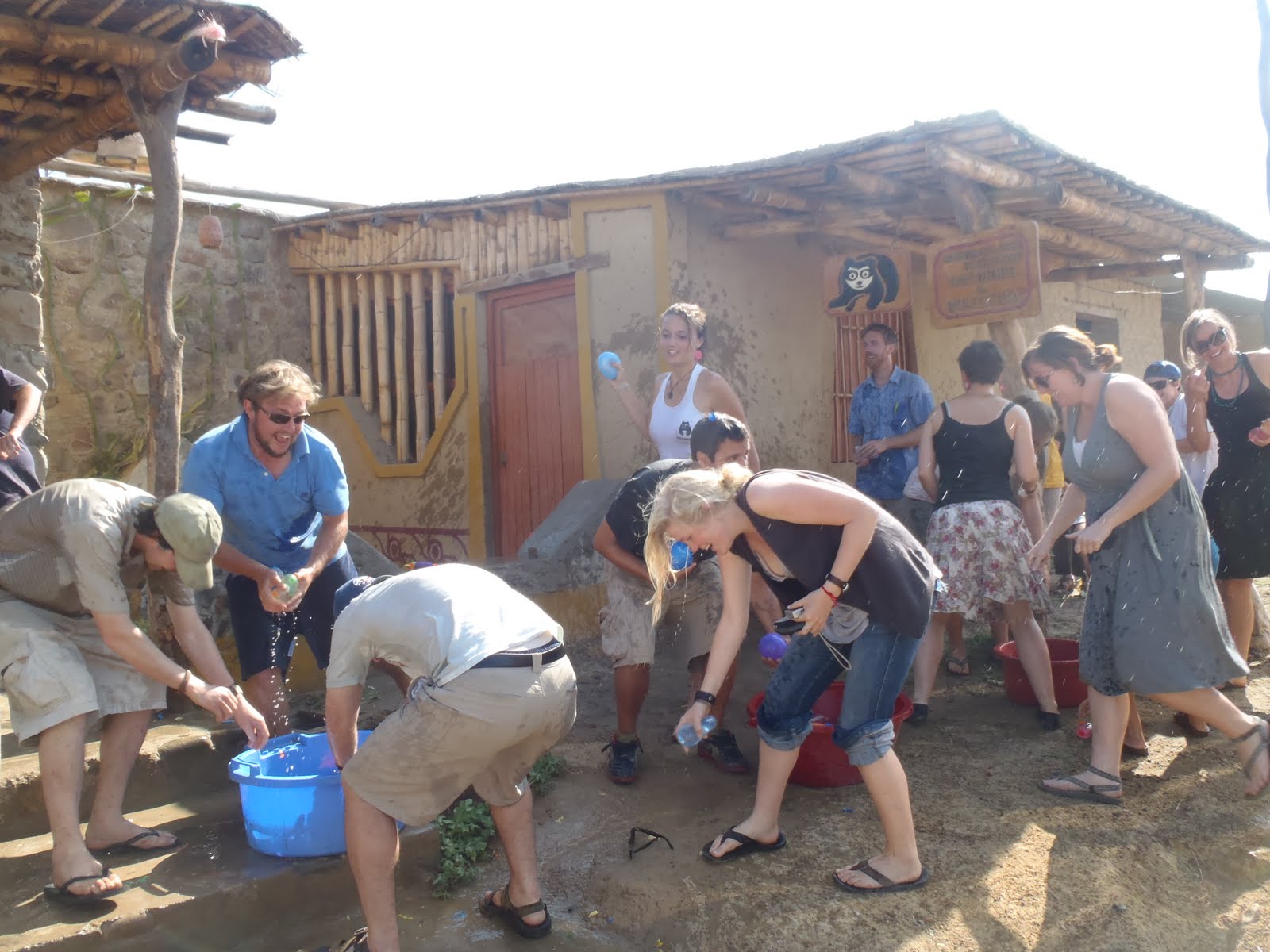
Some believe that his revenge came that afternoon in the form of a surprise water balloon fight between powerpoint sessions. I like to think that that was just good old fashioned fun and a welcome relief from the afternoon heat of Lambayeque. It also turned in to teams of all of us versus our boss and our 3rd year.
And then, like good environmental volunteers, we picked up all of the balloon scraps littered about the street and threw them in the newly installed trash cans nearby.

Like I said, it was a good week. It was a lot of fun and good bonding for everyone. I know that I personally feel a lot more connected to our support personnel in Lima after this week. I have a lot more to share with you but like I said, I don't want this to go from long short story, to novela. It was cool to see another part of the country that is so completely different from where I am living and now I am glad to be going back to my "home."
Blessings.

Sunday, March 13, 2011

Caranaval

Hey all,

Wow, two posts in one month. I really must be getting better at this...or just making more frequent trips to my capital city. Who can say, really? But I actually have an event to write about for you this time and it is called Carnaval!

For 3.5 days, my site was flooded with visitors in town to celebrate the beginning of Lent (or the end of the rainy season, depending on your religion). You may have heard of this party in relation to Rio de Janeiro, Brazil or Badajoz, Spain or even it's much littler sister, Mardi Gras in New Orleans. And here in my site, we celebrate in a similar fashion. Which is a perfect place to start: the fashion of the first day. On this day, those interested take a walk about 1 km out of town to congregate and put on their costumes. Then we all come dancing in to the plaza to ring in the celebration. Once in the plaza, the esteemed judges decide who has the best costumes and awards the prizes accordingly. I, of course wanting the full experience, dressed up. Here's me with some other costumed party-ers.
Unfortunately, all of us in this photo lost the costume contest to a man wearing a complete alpaca skin plus an extra head (i.e. a two-headed alpaca aka caricaria) and a cross-dresser known as la Tigresa (the tigress). In any culture, there is just no competing with cross dressing. I'll have to remember that for next year. And the first half day ends with some regular dancing and some moderate beer drinking.

Then it's on to the next three days. Since they are all pretty much identical, let's just walk through the general schedule of one of these days. Each day has a pair of "padrinos;" literally this means godparents but in this sense, it is simply the people in charge of the party. In the morning, they, their family members and anyone interested in helping chop down a tree from nearby and re-erect it in the plaza. The tree is brought paraded in while the band (trumpets, trombone, drummers, saxophones and clarinet) plays. So you're thinking, maybe this tree things is like Christmas. And maybe it is; except for the tree is a whole lot bigger than a 10 ft pine and instead of ornaments and garlands, it is decorated with streamers and balloons. Also, hidden in the trees branches are plastic buckets, scrub brushes, shoes, blankets, and other assorted useful household items. It looks like this.
Once the tree is up. The whole party (literally, the band and about 400 people) make their way to the padrinos' house to be served their free four-course lunch. The first course is the "entrada" which tends to be a small bowl of spaghetti or one of my favorite dishes, papa a la huancaina (potato in huancaina sauce). After that comes the soup, caldillo. This is a dish typical to Laraos characterized by its lack of ingredients. It is a chunk of alpaca meat in its own broth with a hint of oregano and green onion. Then comes the "segundo" (entree) which is again, a hunk of alpaca meat, rice, potatoes, carrots and peas. After is the dessert, mazamora de calabaza (pumpkin... mazamora). I really don't know how to describe mazamora. It is a pudding-type thing. Anyways it's delicious and you get up from the table completely stuffed.

You waddle out of the house and then the real fun begins. By now it's around 3:30 or 4:00. The band has already eaten and they are beginning to play again. So naturally people are beginning to dance. This traditional dance is easy: you grab a party and thing shuffle-jog around in a circle until the music stops playing. Occasionally you throw in a spin. Simple as that. What makes it difficult is that as you are enjoying your little work-out, other dancers and revelers are armed with bottles of baby powder, silly string, water balloons and other weapons of MESS construction. And this goes on until you and everyone else look like this:
But the party is not over yet. Around 5:00, the party makes a parading dance jog-shuffle down to the plaza where the tree is waiting for it. Now the circle of dancers gets larger and it becomes a circle around the tree full of goodies. The band plays for 5-7 minutes of dancing and then takes a break. During the break, people join the traditional Peruvian drinking circles and continue to make messes of each other. When they band strikes up again, the dancing continues but now that we are in the plaza, there is a twist. In order to get at the goodies in the tree (and to decide the padrinos for next year), it must come down. How do we accomplish this? The same way we got the tree to come down in the first place: we chop it down.

As we jog-dance in a circle around the tree, the padrinos select pairs to literally take a whack at chopping down the tree. The feat takes hours. The music goes on. The beer keeps flowing. Until finally when the tree is ready to fall, the axe is in the hands of some very drunk people. But, since they have been celebrating this festival for years, everyone knows how to not end up with a severed hand. The tree falls and like kids to a burst pinata, everyone rushes to the tree to see what they can claim from its branches.

And when the tree falls, the party is over for the night. Until the next day...or the next year.

The thing about this party is that it brings in a lot of non-larahuinos to the city to celebrate. So I ended up getting a lot more attention than I normally do while in site and doing a lot of Peace Corps and United States representation. I also ended up conversing with a lot of substance-induced talkative people and getting some good theories, stories and ideas. Some of what I learned from carnaval include:
1. A "lluvia hembra" (female rain) is one that takes forever to finish.
2. All germans are racist.
3. If you get hit by a water balloon and don't change right away, you will get sick.
4. Boots and ponchos are acceptable fashion in carnaval.
5. Scented baby powder is more pleasant.
6. A falling tree is actually quite easy to avoid.
And my all-time favorite.
4. The urine of a virgin will bring down a fever.
Blessings.

Wednesday, March 2, 2011

The Transportation Situation

Hey folks, as you can guess by the title, in this blog I want to talk about transportation. To and from site, it is always an adventure. Because you see, since I live 9 km off the main highway, the cars that come and go are few in Laraos. And since it's the rainy season, sometimes you get some unexpected hindrances on your journey.

For instance, when I took my summer school class on a field trip to the lake, we had to wait about a half hour while the workers we encountered finished removing and replacing a bridge that had washed out. Yes, that is something. But what I find to be even more something is that they did that work very quickly. Here they are working.
And here are the kids playing and passing the time by our car we took.
Also, how many people do you think rode in that car up to the lake? Now remove yourself from the American transport safety standards and remember that in Peru, there is always room for one more. Now that the mindset has changed, would you believe that 5 children and 8 adults fit in to this car? Well they did, so believe it. And we had a great time.

But what I really want to talk to you about is the transportation experience which brought me and my two site mates to the big city yesterday. The plan was to haul some recycling in to the city to sell, taking advantage of the fact that my municipality's truck was going empty in to the city. I would ride in the cab with the two drivers (they have to switch because it's a long trip) and then my friends volunteered to ride in the back of the truck with the recycling. There would be plenty of room for all. We could even steel ourselves for the fact that the truck was leaving at 2:00 in the morning. No problem. We could sleep on the way.

Now here's where some lack of communication and lack of foresight complicate this plan. We load my recycling in to the car and then they load another 40 boxes of empty beer bottles. Not only does this add volume to the load in the back of the truck taking space away my friends' recycling, it also adds weight, which as we all know will end up sucking more gas. Remember this because it will come back. Not only are we carrying more things than I was aware, but then 2 more people and a dog climb in to the back. So I fret about how we will all fit. But the 2 people and dog end up getting off, my friends and their recycling get loaded on and we are on our way. Problems solved, right?

Wrong. Remember that bit about the heavier load than we were expecting. Well, just as we came over the last mountain, we ran. out. of. gas. Luckily it was on the downhill side of the mountain because we could take advantage of that and coasted for about a half an hour down to the nearest town. But since we had left at 0 Dark-thirty there was no one awake/open to tend to our needs. I burst out laughing when the three petrol trucks ironically zoomed past us. How was this one solved? We flagged down another truck and siphoned gas out of their tank and in to ours using a bucket and a hose. And we were on our way to roll in to town about 8:00 and sell our recycling.

Lest you think that I am complaining about the trip, let me tell you about the good things. 1) I successfully got the support of the municipality in selling recycling from our pueblo for profit. 2) The adventure and the story make it totally worth the uncomfortable and sometimes frustrating trips. And 3) Although leaving at 2:00 in the morning can be a little difficult on the body and the sleep cycle, you are rewarded with a clear sky and more brilliantly bright stars and shooting stars than you can count.

Blessings.

Sunday, February 13, 2011

Smile for the Camera

Hey all,
Due to the lack of photos in recent posts, this one will be less words and more pictures. I know your eyes have been starving for some visual images. So here we go.
This one is good and embarrassing. Check out facebook for the video of me dancing in this get-up.
Here I am posing with the Peace Corps big wigs. Our country director, the U.S. ambassador to Peru and the boss of the environmental program, on swear-in day.
Here's some of the family and my site mate on New Year's Eve.
Me and the other crazy gringa in Laraos, Marjan, jumping into Lake Cochapampa on New Year's Day.
This is just one of the pretty views very near my house.
This is my summer school class on the first day.
And this is us playing with water!
This are our petreglyphs.

And here we are giving a very important presentation to the mayors in our area. Don't we look official in our vests?
And these are my kittens. They keep me company on the rainy afternoons.
Blessings.


Friday, February 4, 2011

Welcome to the Family

Hey friends. It's been a while since a post and I apologize for that. To remedy the situation, here's a new post! I promise, photos will be coming soon. So anyway, I want to talk about family. Specifically about how when you move into a small town in Peru, you inherit a whole bunch of family. Let me explain what I mean.

What I've found is that rural communities in Peru are not so different from rural communities in the States. Town meetings are announced on a loudspeaker and around mid-afternoon, the shepherds come in from the fields with their lambs to keep at home where it is safer. Everybody knows everybody and everybody greets each other in passing on the streets. It's not an impersonal greeting, instead it is always "Tio (or Tia), buenas tardes." And this is what I mean by inheriting the family. I now have a town FULL of aunts and uncles. To some of the older ladies, they'll even call out, "Mamita, como estas?" And my new extended Peruvian family is definitely looking out for me. Now I find that when I am walking around the streets I greet the ladies with a "Tia, buenos dias."

Since starting my summer school/camp, I've also inherited a few kids - let's call them cousins since their moms are my aunts. And they are a bundle of enthusiastic energy, ready to learn and play whatever I throw their way. The classes I'm giving are now 3 days a week from 9:30 to about 12:30 and to give it a name, it's Environmental English. Because I want to talk about nature but to get people to show up, I offer to teach some English too. If they words happen to be nature-oriented, well, that's just how it goes. We've talked about water and played water games, and we talked about garbage and did a town cleanup. They were so excited about the clean up that they asked to do one every week. And that is why the class is now 3 days a week. The third is purely activity and it's clean up the town and set aside the recycling day. We also did a day of art projects with recyclables and a day where we talked about the seasons and natural disasters. That ended up being really fun because we did a natural disaster obstacle course on the playground. In the next few weeks we'll be playing in the garden, talking about animals and taking a few hikes. So those are my cousins.

And now for my kids. Don't freak out. They aren't human but they are definitely babies. In a moment of pity and as a sucker for cats, I've adopted two kittens. They are from the town over and the owner of their mom was going to kill them if they didn't have a home (that's their form of controlling the pet population) and so I offered mine. So now Cora (short for Corazon) and Messi (short for Mezcla and as an homage to the soccer great) are slowly (really, very slowly) learning how to use the litter box and currently sleeping on my lap. They are good company for me and a good topic of discussion with the rest of my family in town.

So now you know a little bit more about the family I've been plopped into and understand a little bit about who I'm encountering in my day to day. I hope soon to get some pictures up for you to see. I hope everyone in the snowy snowy north is staying sheltered and warm. Blessings.